Traquair’s Tenants, Cottars and Workers
Traquair's Tenants, Cottars and Workers
Traquair House, situated in the Scottish Borders in the south east of Scotland, dates from 1107. It was originally a fortified tower house and was used over the centuries as a royal hunting lodge when the monarch and his entourage would come to hunt deer and boar in the ancient Ettrick Forest nearby. Today, it is a major tourist attraction with visitors coming from all over the world to enjoy its magical atmosphere and absorb themselves in its fascinating, and sometimes turbulent, history.
The Stuart family was established here in 1491 with the arrival of James, son of the Earl of Buchan, half uncle to King James III. James’s descendants still live in the house today, making it the oldest continuously inhabited house in Scotland lived in by the same family.
James, the 1st Laird, was killed at the Battle of Flodden in 1513 when the Scots army was defeated by the English. Sir John Stuart, the 4th Laird, served as captain of Mary Queen of Scots’ bodyguard in the 1560s. In 1633 the 7th Laird, also Sir John, was granted an earldom by King Charles I and became Lord High Treasurer of Scotland two years later. The 4th Earl / 10th Laird, Charles Stuart, was one of the earliest in Scotland to be identified as a ‘Jacobite’, a supporter of the exiled Catholic Stuart King, James II (VII of Scotland). He served two spells of imprisonment in Edinburgh Castle for his allegiance to the Jacobite cause which sought to return the Stuarts to the throne of Great Britain. Charles’s son, the 5th Earl / 11th Laird, also served time in the Tower of London following his involvement in the 1745 Jacobite Rising when Bonnie Prince Charlie came over from France to attempt to regain the throne for his father.
Clearly, the Stuart family of Traquair took the ‘wrong’ side in both religion and politics, but all the while it continued to run its estate and safeguard the records of its tenants, cottars and workers over the centuries. The estate archives, which have until now been somewhat in the shadow of the archives of the members of the family, are now being researched for the first time – and what genealogical treasures they reveal!
While momentous events were unfolding in Scotland, and the rest of Britain, Traquair’s estate workers were just getting on with their lives, regulated by nothing more than the seasons. The archives do not reveal their religious or political persuasion but it would seem from other sources that, by and large, they were Presbyterians who would have attended Traquair or Innerleithen Kirks on the Sabbath, with their morals guarded over by the kirk sessions.
Research to date has focused mainly on people and properties in Traquair parish but the estate extended into the neighbouring Innerleithen and Yarrow parishes. Traquair and Innerleithen were in the county of Peeblesshire, while Yarrow was in Selkirkshire. (Today, they are all included in the Scottish Borders council area).
Traquair’s estate records are rich in names, especially for the period long before the 19th century census returns and the introduction of civil registration of births, marriages and deaths in 1855. Exploring them, however, is much more than harvesting them for personal names. What makes them so fascinating is how much they reveal about how these workers on the land lived their daily lives.

A lovely set of tenants’ signatures from the 1690s, with 4th Earl of Traquair’s more educated hand at the top. The Eckfords were long-established on the estate.
Estate Tenants [Tennents]
A tenant is defined as a person who holds a farm and/or land from a landowner, paying rent in cash and/or kind, and holding it for a set number of years in accordance with the terms of the lease or ‘tack’, as it was called in Scotland. Tenant farmers were at the top of Traquair estate’s hierarchy. The duration of their tacks ranged from three years to nineteen years, and they could be extended or terminated early by agreement between the earl and tenant.
Traquair’s five earliest surviving tacks are dated between March and May 1645 when the Wars of the Three Kingdoms were raging. Earlier, the 1st Earl had been impeached and heavily fined by the Scottish Parliament for his loyalty to King Charles I, whom he had attended at his court at Oxford, but now he was turning to more prosaic matters – clearly keeping his head down!
These early tacks give us the names of new tenants (sometimes with shared tenancies), the names of places where they already held tenancies and the names of the current tenants, so we get a lot of information from them, and, assuming these men were of a certain age, a foothold into the late 16th century. Here is one:
18 April 1645
Tack between 1st Earl of Traquair and John Hutcheson in Kailzea [Kailzie] and William Inglis in Plora of the lands of Little Ormiston presently possessed by Alexander Vaitch [Veitch] in Nether Horsburgh for the space of five years
But it is not only tacks which supply us with details of tenants. There is a wonderful document in the archives which gives us the names of the Traquair tenants in 1674 which was created in response to the activities of the Covenanters, hard-line Presbyterians who must have been in the neighbourhood garnering followers. This document is dated 30 September 1674 and is a
Bond given by Traquair tenants on behalf of themselves, their wives, children, cottars and servants that they will not gather in [Covenanters] conventicles either in their houses or in the fields as the same are defined by Act of Parliament under the pains therein contained being £25 Scots for each tenant labouring land, £12 for each cottar and a fourth part of his yearly fee for each servant man…
It contains the names of twenty seven of the earl’s tenants, and it is exciting to see surnames listed here which crop up time and time again into the late 19th/early 20th centuries.
Moving into the 18th century, this tack below shows just how much can be gleaned from a single document, giving us not just personal names but also a snapshot of a rural way of life in the Scottish Lowlands in the middle years of the 18th century.
4 February 1760
Articles of Agreement for a Tack Betwixt The Earl of Traquair & Andrew Gibson Tennent in Pirn –
19 year tack of lands of Damhead and Shillinglaw presently possessed by Alexander Thomson together with houses and yard formerly possessed by William MacIver and the Coat House in
Walkerknow presently possessed by William Hog
It goes on to state the terms of the tack:
Servitude of grazing 2 horses and 3 cows for the tennent of Traquair Mill; Privilege of casting 2,000 divots [pieces of turf or peat] a year upon the Damhead lands; 2 dargues [days’ work] of turs [turf, peat] conform to use and wont [habitual way of doing].
And then comes the rent:
60 guineas of grassum (the initial down-payment) and “the yearly Rent of Eleven hundred Merks Scots money… and Twenty Loads of Peets or four shillings Scots for each Load, Eighteen kain hens or three chickens or seven shillings Scots for each hen, and the carriage of Twenty four Loads of Coalls at ten stone the load or ten shillings Scots for each load all in the option of the said Earl”.
The estate accounts reveal how tenants could negotiate their rents. For example, William Laidlaw, tenant of Blackhouse in Yarrow parish in the 1750s, preferring not to commit to the carriage of twenty eight loads of coals to Traquair House, converted this obligation into an additional cash payment of £1 3s 4d. to the earl. He also converted an ‘ox grass’ (i.e. pasturage for someone else’s cattle) into a cash equivalent of 6s 8d. With John Ronaldson it was the other way round – he supplied the earl with forty wedders (full-grown male sheep) to put into his parks, thereby reducing his annual rent by £14. Supplying bolls of bear (barley, the main crop grown in the area) to the earl’s
family was frequently used as a means of reducing cash rents.
Women, usually widows of tenants, could be granted tacks in their own right, and these can be useful in identifying other family members. Here are two:
8 & 9 March 1698
Tack between 4th Earl of Traquair and Anne Veatch, relict of John But, tenant of Menerhead [Manorhead], of the lands of Douglas Craig presently possessed by James Tod, for 15 years
5 May 1757
Tack of two lands of Easter Bold between 5th Earl of Traquair and Elizabeth Hislop, relict of John Scot, late tenant in Scrogbank, and James Scot, their son, for fifteen years
Women tenants can sometimes be picked up in other records too, so it is possible to keep track of them.
Arrears of rent (‘rests’) feature prominently in the archives and much can be gleaned from these. The earliest surviving account of arrears is labelled “Rests within the Barronie of Traqr and Inderlithane preciding marts [Martinmas] 1685” and contains several names noted in the 1674 Bond above, with most of the surnames recurring down through the centuries. There are some poignant snippets in a mid-18th century estate account book relating to both tenants’ and cottars’ arrears: “Thomas Tait cottar in Inverleithen dead & bankrupt”; “Robert Barry in Inverleithen Bankrupt and removed out of the Estate”.
But in 1737-38 there appears to have been a more lenient attitude taken to rent arrears when nine tenants were let off under the heading “Forgiven the Tennents” so perhaps it was acknowledged by the earl that times were hard: “8 August 1737 Forgiven Alexander Dickison in Ormiston of his bygone rents £33 6s 8d”; and on 22 February 1738 forgiven “to William Dickison’s relict in Ormiston £16 13s 4d”. Possibly the earl was also taking into consideration the family’s past service to the estate. The Dickisons [Dickiesons] had been tenants of Ormiston in Innerleithen parish since the 17th century. On 5 November 1685 a tack had been given by “the [4th] Earl of Traquair to William Dickieson, John and James Dods, and James and Thomas Tait, all present tenants of the lands of Ormiston, of the town and lands of Ormiston for the space of nine years”.
The estate rentals are another good resource for uncovering details of family history, supplying the names of the tenants (possessors) of the various properties down through the centuries. The earliest rental in the archives is dated 1659, drawn up following the death of the 1st Earl in that year. It is possible to trace generations of families through the rentals – the surnames Dickson, Tait and Thorburn, for example, appearing in 1659 are also listed in the rental for 1861, drawn up following the death of the 8th, and last, Earl of Traquair.
The estate archives also reveal much about tenants’ living spaces. When a new tenant entered a property a detailed ‘Inventary and Appretiation’ of the dwelling house, and also the farm buildings, was made by local tradesmen. In May 1758 George Ballantine took possession of Douglas Craig and Kirkstead in the Yarrow Valley. James Paterson, wright in the Know of Traquair, and William Thomson, mason and wright in Innerleithen, were mutually chosen by the earl and Ballantine to carry out the survey. Their report on the house tells us that it was constructed of stone, two-storeyed, had a west room, an east room and a kitchen, eight windows, three inner doors, an outer door, a cat and clay chimney and a thatched roof, the whole valued at £10 10s 9d. A comparison of all the surviving inventories & appretiations would tell us which tenants had the better dwellings. Together, they constitute a remarkable record of 18th century vernacular architecture in the Scottish Borders.
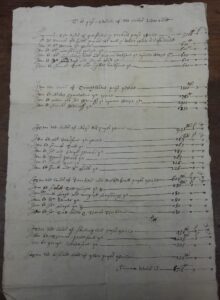
Traquair’s earliest surviving estate rental, 1659
Cottars
There appears to be a number of definitions of cottar including a tenant occupying a ‘cot’ or ‘coat house’, with or without land attached to it, and a married farmworker who has a coat house as part of his contract. From a study of the Traquair estate papers it seems that a cottar could pay rent directly to the earl or to the tenant farmer on whose land his coat house was situated. The cottar was generally obliged to give some labour to the earl, usually at harvest-time, as evidenced by two documents in the archives.
A rental of 1751-52 has two columns for rent, one ‘paid by sheering’ and the other a cash payment. Some of the cottars, listed under their place of abode, paid in cash while others paid by sheering as well as cash. This option presumably reduced their cash payment. For example, Walter Steven in Avenuehead paid 13. 4 ‘by sheering’ and £1 3s 4d in cash. The 13. 4 would have been the monetary value of their labour at the harvest, but this is not made clear.
And there is a list of “Cottars in Traquair parish who are to give two days at The Earl’s Hay Anno [year] 1767” with a record of who had already been paid. This document is interesting in two respects: 1) seven women are listed, all presumably widows who were allowed to stay in their coat house after their husbands had died; 2) not all of the men listed as cottars were agricultural labourers as we know from other documents that some were tradesmen – Charles Breadie in The Rigs was a wright, as was James Paterson in the Know of Traquair, while John Melross in Tannielburn was a skinner.
It looks from papers winding up the estate of James Johnston, the miller at Traquair Mill who died in 1758, that he had possession of several coat houses and had cottars working for him. Inventories of his debts include debts due by him to his workers and also debts due to him for house rents.
A Memorandum from 1787 is particularly revealing about the status of cottars and tenants on the estate: “The Tennents make difficulty to give Divots [turf] for mending The Earl’s coat houses it may be thought proper to give up the coat houses to them”. Would they take better care of them if they actually owned them and received the rents? The document also includes some interesting details about some of the cottars. In addition to naming more tradesmen – Andrew Thorburn, ‘tayler’, William Paislaw, mason, and Robert Lees, skinner – there is Robert Scot, “the Minister’s man” who pays 10s annual rent. And there are more women – Marian Wilson, May Graham and Mary Dickson each pay 10s yearly while William Graham’s relict (not named), John Brunton’s relict (not named) and Jannet Rodger (possibly widow of Andrew Rodger, shoemaker) live in their coat houses rent-free. Clearly, the 7th Earl was a benign landlord.
‘Herds’ (men who watched over sheep and cattle) and ‘hinds’ (ploughmen or married farmworkers) were also classed as cottars but these designations appear to have been more widely used in the 19th century.
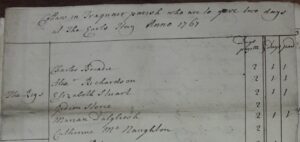
Cottars fulfilling their obligation to 6th Earl of Traquair
Estate Workers
Tradesmen have already been mentioned above – here I will discuss ‘day labourers’ who, as the term suggests, were paid by the day rather than being paid a fixed yearly wage, and other workers who were paid by other measures.
Alexander Dickson had certainly been hard at work in the 1730s. On 15 November 1737 he would have brought home a long-awaited fistful of cash: “for working 14,060 sclates [slates] betwixt Mart[inmas] 1734 and Mart[inmas] 1735” at £4 per thousand, working 200 slates for Traquair House, working 9,760 slates from 1735 to 1737, constructing many roods of drystone dykes [walls] for the newly-enclosed parks on the estate at 8s per rood, and countless days of unspecified labour over these years. Let’s hope he had money in reserve to tide him over until payday! And let’s hope that not too much of his dyking was destroyed in a spate of vandalism (“irregular practices”) in April 1750, perpetrated by cottars, including William Linton, herd in Tannielburn, who were expressing their grievances at new ways of running the estate.
Some of the work of day labourers was seasonal. A scrap of paper titled “Paid the Mower Anno 1786” lists Adam Scot and George Thorburn being paid for twenty eight days’ work and James Brunton for twenty nine days, all at 14d a day. Daily workers in the garden in the same year earned a trifling 3d per day.
From the 19th century abstracts of accounts it would appear that female farm workers were paid by the day as and when their services were required. In 1833 Kate Noble spent forty two days as an assistant sorting cattle earning the grand total of £1 15s 0d. Janet Lockie and Janet Scott, described as ‘bondagers’ (female field workers performing bondage service, supplied by farm tenants in accordance with the conditions of their tenancy) only worked for seventeen and fifteen days respectively, both at 10d per day, possibly at the harvest. Betty Nicol was also paid 10d per day, working thirty three days. Her entry in the accounts is alongside that of her husband, James, who was being paid a hefty £5 1s 6d for a quarter of his yearly wages, guaranteeing him a regular income. A year later Bell Brydon, a shearer, worked at the harvest on seventeen days at 22d per day, so shearing was ‘a cut above’ bondage work. In the same account ‘extra potato gatherers’ did not even merit a name!
It would appear that day labour on Traquair estate was still going strong into the second half of the 19th century. In June, July and August 1863 John Leggat was carrying out a range of tasks: cutting wood, making gates, making doors, at the kiln, and painting the wire fence. We see from the 1861 census return that he was living at Bridge End, Innerleithen, and was a journeyman joiner, living with his niece and nephew who were both woollen factory workers. With this new local industry just taking off the nature of employment in the area was about to change and would no longer be focused around the estate.
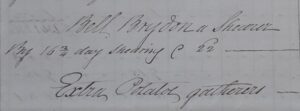
The potato gatherers shall remain nameless!
Estate Families - the Brunton Family
To further illustrate the point that estate archives can be a valuable genealogical resource for family historians I will now look at just one family, the Bruntons, who tenanted land in both Traquair and Innerleithen parishes, in more detail.
The earliest record we have for them is dated 1645 when Robert Brunton obtained a tack of Seithope. As we already know, John Brunton is named as a tenant “in the toun of Traquair” in the 1674 document. Then we have:
1687 – John Brunton, portioner of Bold
1692 – Thomas Brunton, tenant of Wester Bold
1694 – James Brunton, tenant of Bold and Scogbank; John Brunton, tenant in Grieston and Orchard
1697 – James Brunton, elder and younger, and John Brunton, tenants in Caberston and Grains
1720 – James, John and Robert Brunton, tenants in Caberston and Grains
1747 – Isobell Tait, widow of John Brunton, tenant in Grieston, Orchard and Birks
1749 – John Brunton, tenant in Glen; spouse, Elizabeth Dalgliesh
1749 – Adam Brunton, tenant in Bold; spouse, Marion Dalgliesh
1755 – James and William Brunton, merchants in Peebles, tenants of Scrogbank; mother, Helen Dickson
1766 – John Brunton, younger, tenant in Scrogbank
1767 – John Brunton, tenant in Tannielburn
1786 – James Brunton, mower
1832 – payment to William Brunton for working at the ram
This could pose quite a challenge to work out all the family relationships!
I suspect that by the early 19th century the Bruntons had slipped down the estate hierarchy somewhat, but this would need further study. I charted the ‘progress’ of the family in the 19th century census returns for Traquair from 1861 to try to establish if it was on the decline in the neighbourhood. These are the results:
1861 – 9; 1871 – 5; 1881 – 22; 1891 – 20; 1901 – 9; 1911 – 0
An interesting exercise but, as the Traquair estate archives for the later 19th century are not complete they are not likely to explain the fluctuations unfortunately.
Estate Families - James Johnston, miller at Traquair Mill
Among the estate archives at Traquair there are several sets of papers relating to the personal affairs of tenants and other estate workers. Perhaps the most interesting are the papers dealing with the winding-up of the estate of James Johnston who died in March 1758. These shed light not only on members of his immediate family but also on the workings of a ‘mini’ estate and indeed, his lifestyle.
From the records we learn that James was first married to Elizabeth Johnston and they had one son, Robert, a journeyman baker in London at the time of his father’s death. Possibly Elizabeth died in childbirth. His second wife was Agnes Pot (who died only a few months after him in October 1758) and together they had two sons, James, a wright, and John, a miller.
The earliest record we have of James’s tenancy at Traquair Mill is a bill dated 3 September 1746 for eighty six bolls of oatmeal as the balance of his ‘victual rent’ due to the Dowager Countess of Traquair, with records of his payments and a final discharge/receipt from the countess dated 24 December 1747 (just when her son, the 5th Earl of Traquair, was incarcerated in the Tower of London for his Jacobitism – but still, life goes on…).
14 April 1759 was a busy day for paperwork! It was the day on which James’s estate was wound up by his sons, James and John, and it has furnished us with a wonderfully complete record. There are the lists of debts due to and by James, an inventory of cattle and corns, an inventory of household effects and “labouring utencills” that belonged to James and Agnes, and finally, the overall “State of Affairs” which reveals that the estate, the “sum of free fund” amounted to £33 1s 6d. This sum was divided equally between the three brothers, with Robert in London having to wait until James and John had discharged their father’s debts before receiving his share – a mere five years later!
Let’s take a quick look into the inventories: five horses valued at £19 10s 0d, ‘nolt’ (i.e. cattle) including cows and calves valued at £11 15s 0d and sheep (thirty two ewes and four hogs) valued at £13; the ‘corns’ were seed oats (“sowen and to sow”), seed beer (barley) and seed peese (peas). Now some of the household items, hardly the contents of a humble cottar’s abode – wainscot oval table, armchairs, looking glass, 8-day clock, two feather beds with pillows and bolsters, thirty six pairs of blankets, twenty two trenchers (large plates for serving food), a set of china cups and saucers, six silver teaspoons, twelve drinking glasses, two dozen delph plates, five tablecloths and nineteen table napkins. (James and Agnes clearly did a lot of entertaining!) In the cellar there were thirteen dozen bottles, a bottle rack, barrels, a brewing vessel and other brewing equipment.
Looking at the Johnston estate as a whole, with outdoor labour supplied by the cottars mentioned earlier and domestic help given by two house servants, Christian Thomson and Jannet Stewart, mentioned in the list of debts, we can see that it would have been a largely self-sufficient enterprise – not to mention the workings and produce of the mill itself.
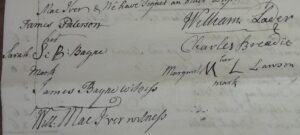
Names of those who ‘appretiated’ James and Agnes’s household effects – note that while the men could write their names the women could only manage their initials.
19th Century Incomers to Traquair
Having identified many ‘new’ surnames in the abstracts of accounts for the 1820s-30s and other accounts for the 1840s-50s it was time to check the 1851 census returns to see what light they could shed. A quick search through some of these revealed that most, but not all, of the new arrivals had been born in other parts of the Scottish Borders, not too far away, and had come to Traquair in the 1820s. It appears to have been quite an influx. By 1851 they were well-settled in the local community.
To mention just a few, living as neighbours in the row of cottages at Avenuehead, only one head of household, Alexander Brydon, a tailor (whose forebears had been tenant farmers on the estate) had been born in Peeblesshire, at Innerleithen. There was one Irishman, Archibald McGuigan, an agricultural labourer (‘ag lab’) from County Antrim, living with his wife, Isabella, from Biggar in Lanarkshire (26 miles from Traquair) and their three children, James, 20, journeyman gardener, Isabella, 16, ag lab, and Thomas, 15, scholar, all born at Traquair. Next door there was the Swanston family, with William, born at Yarrow, Selkirkshire, an ag lab, his wife, Isabella, born at Wilton, Roxburghshire, and their five children, the eldest, Ann, aged 19 and a house servant (presumably in the household of the 8th Earl of Traquair just down the avenue), all born at Traquair.
Just along the road at Tannielburn, where some of the cottars mentioned earlier had lived in the coat houses, there was Janet Lockie, born at Yarrow, unmarried, 62, pauper (ag lab), living in the ‘Ag. Lab. House’. Poor Janet. Was she the bondager in the early 1830s accounts?

Avenuehead

The final resting place of Traquair’s tenants, cottars and workers
Credits
Margaret Fox
Traquair Archivist
This article first appeared in British Connections, the magazine of the International Society for British Genealogy and Family History, March 2021.
Images of documents reproduced with permission of Catherine Maxwell Stuart, 21st Lady of Traquair
Use this link to work out present day values for the sums of money noted in this article –
https://www.nationalarchives.gov.uk/currency-converter/#mid