Napier’s Bones
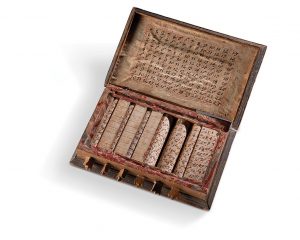
John Napier could be said to have invented the forerunner of the computer.
The difficulty of multiplying very large numbers was common and was simplified by John Napier, a Scots mathematician, who published the first table of logarithms in 1614 and immediately recognised as being a powerful computational tool.
However, Napier did not stop there. He went on to devise calculating rods to carry out this process and to help introduce beginners to arithmetic. These later became known as Napiers’ Bones, and described by the inventor in his work, Rabdologiae, published in 1617.
Using the rods or “bones” calculations can be made quickly and easily by turning the rods to the correct positions. These early calculators were made of rectangular strips of bone, metal or box wood as this one at Traquair is. Box was used as it was light and easy to carry around.
An example of how the device works was set out be Napier in the Rabdologiae – the multiplication of 1615 x 365.
Put strips headed 1,6.1,5 side by side as shown in the right of the diagram. The results of multiplying 1615 by the 3, the 6 and the 5, are then easily read off as 8075, 9690, and 4845, some simple diagonal additions of two digits being necessary to obtain these results. The final product is then solved by an addition, as illustrated in the diagram.
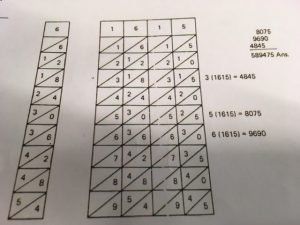 Napier’s Bones diagram